
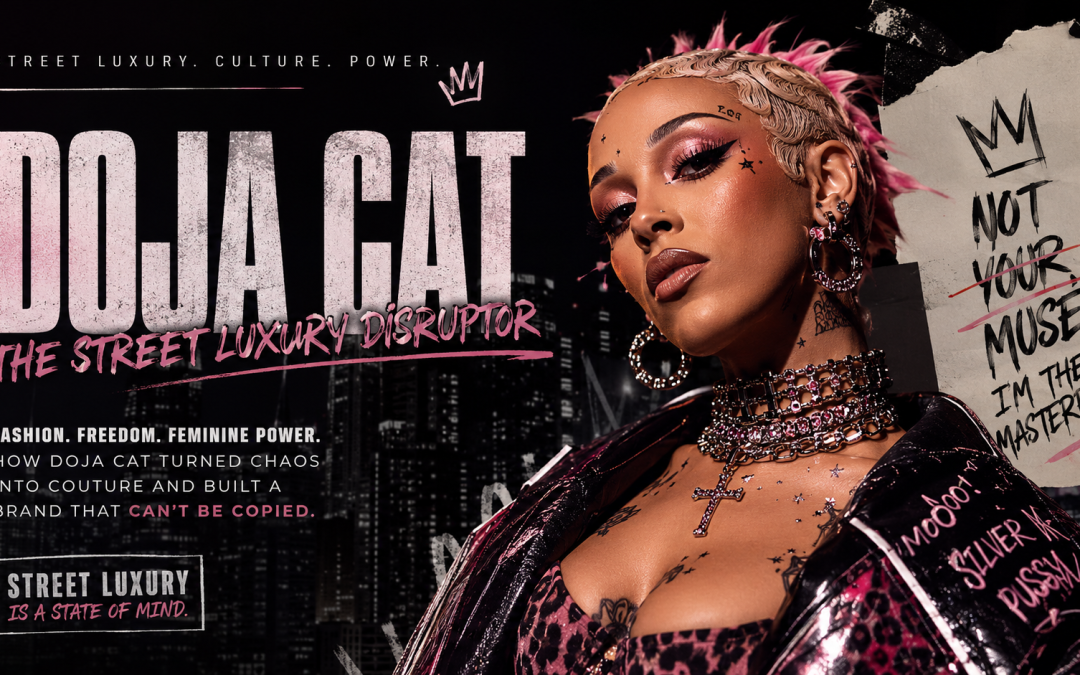
When the rules are already broken, the only thing left to do is build a new runway.
There are pop stars, there are rappers, there are fashion icons—and then there’s Doja Cat.
She exists in the uncomfortable space between all three, refusing to stay inside the boxes the industry keeps trying to build around her. One week she’s delivering radio-ready records. The next, she’s walking into Fashion Week covered in thousands of crystals, painted head to toe, or wearing silhouettes that look more like contemporary sculpture than celebrity styling.
That’s not confusion.
That’s brand architecture.
Street Luxury Isn’t About Money
Street luxury has never been about wearing the most expensive outfit in the room.
It’s about making people remember you after you’ve left it.
The culture was born where creativity had to outperform resources. Luxury became attitude before it became a price tag. Designer labels eventually borrowed from neighborhoods that had already mastered the art of making everyday pieces feel aspirational.
Doja Cat understands that equation.
She can pair couture with chaos, vintage with futuristic makeup, oversized streetwear with high jewelry, and somehow make it feel intentional instead of random.
Her wardrobe doesn’t chase trends.
It creates conversations.
Performance as Identity
Many artists use fashion as decoration.
Doja Cat uses fashion as storytelling.
Every public appearance feels like another chapter in an ongoing creative experiment. Instead of asking whether people will like the look, she asks a more valuable question:
Will they forget it?
Usually, the answer is no.
That willingness to embrace risk has become one of the strongest parts of her personal brand. While many celebrities spend millions trying to appear universally likable, Doja Cat often chooses memorability over comfort.
In today’s attention economy, that’s a powerful strategy.
Controlled Chaos
The internet loves categories.
Doja Cat seems determined to destroy them.
Singer.
Rapper.
Pop star.
Fashion muse.
Internet troll.
Performance artist.
None of those labels fully explain her because she isn’t trying to fit neatly into one lane. Instead, she’s built a creative ecosystem where humor, controversy, beauty, music, and visual art all reinforce one another.
The result is a brand that feels unpredictable—but never accidental.
The Luxury of Authentic Weirdness
Luxury has traditionally been associated with exclusivity.
Street culture has always celebrated originality.
Doja Cat blends those philosophies into something uniquely modern.
She doesn’t sell perfection.
She sells permission.
Permission to experiment.
Permission to evolve.
Permission to disappoint expectations if it means discovering something more interesting.
That mindset resonates with a generation raised online, where identity is fluid and creativity moves faster than traditional gatekeepers can approve it.
Lessons for Creative Entrepreneurs
Whether you’re building a fashion label, launching a creative agency, or designing your first product line, there are valuable lessons in Doja Cat’s approach.
-
Build recognition before chasing approval.
-
Let visuals become part of your storytelling.
-
Treat every appearance like a campaign.
-
Make your audience curious about what comes next.
-
Create a brand that evolves without losing its personality.
People rarely remember the safest creative in the room.
They remember the one who shifted the atmosphere.
Final Word
Doja Cat represents a new era of street luxury—one where artistic freedom is the ultimate status symbol.
She proves that luxury isn’t always polished, quiet, or traditional. Sometimes it’s loud. Sometimes it’s strange. Sometimes it’s covered in body paint, couture, and unapologetic confidence.
The future of street luxury won’t belong to the people who imitate yesterday’s icons.
It will belong to the creatives bold enough to become their own.